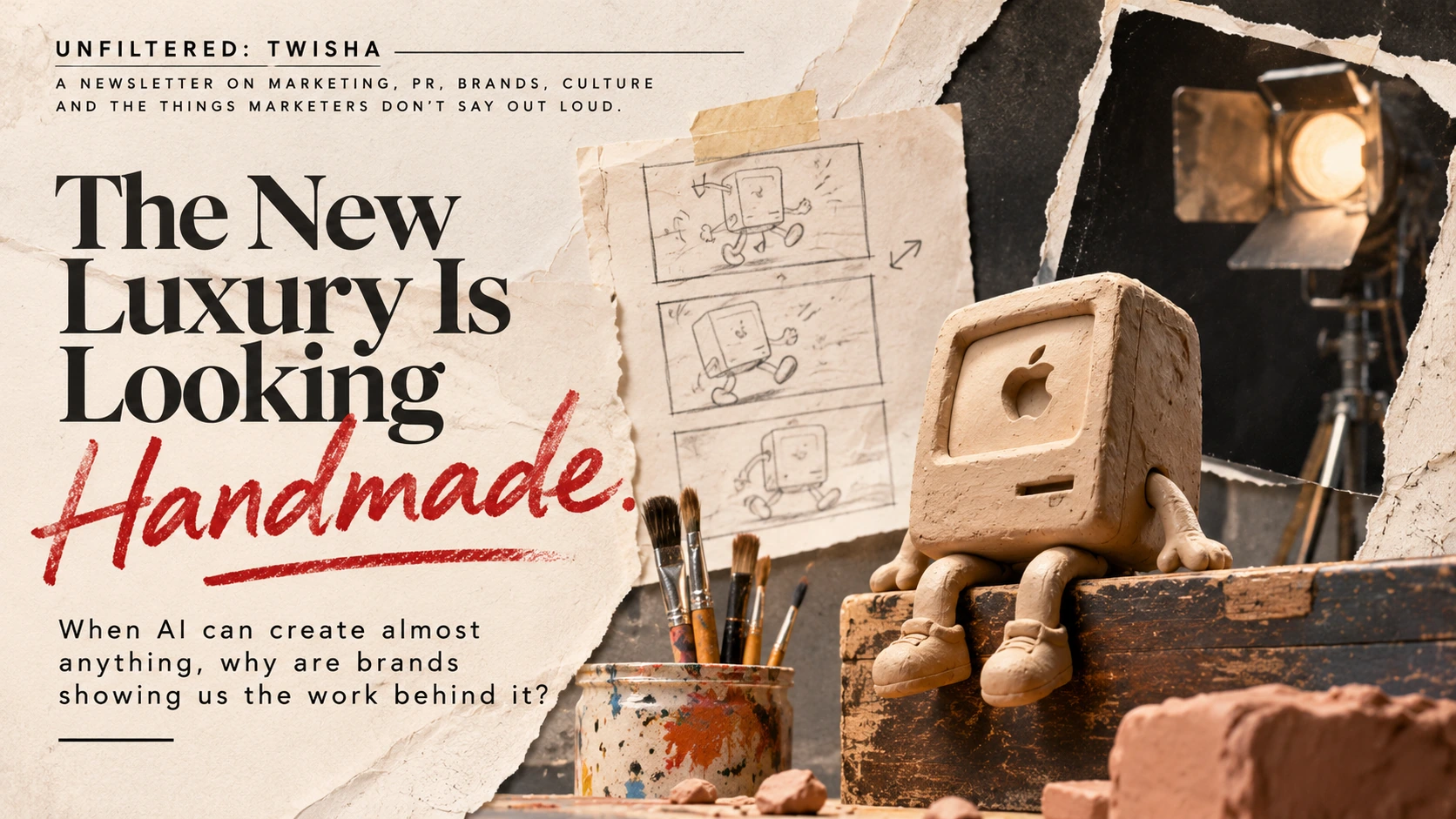
Tuesday, November 3, 2026 | Advertising × Brand Psychology × AI × Culture
Something interesting is happening in advertising.
While brands are investing in AI to produce content faster and more cheaply, others are deliberately choosing production methods that are slower, more expensive and visibly human.
Apple has used handcrafted clay animation to advertise one of its most AI-capable computers. Levi Strauss & Co. and e.l.f. Cosmetics are among the advertisers experimenting with practical animation and puppetry.
On November 3, The Wall Street Journal examined this growing interest in handmade advertising, reporting increased demand for studios specialising in stop-motion, puppets and practical effects. The Wall Street Journal
But the more compelling question isn't whether handcrafted advertising is making a comeback.
It's why brands are increasingly interested in showing consumers how much work went into making an advertisement.
And there's a particularly interesting Indian example that adds another dimension to the story.
When AI makes everything easier to create, the evidence of human effort becomes part of what we're buying.
Unfiltered: Twisha | November 3, 2026
I want you to imagine two advertisements.
Both are beautiful.
Both have exceptional lighting, carefully composed frames and impressive visual effects.
Both tell a compelling story.
But there's one difference.
The first was generated using AI in a matter of hours.
The second took nine weeks to produce, with artists physically sculpting characters, moving them frame by frame and building miniature sets.
Now imagine you discover how each advertisement was made.
Would you feel differently about them?
Not necessarily because one looks better.
But because one required a kind of human effort you can recognise.
I think that distinction is becoming increasingly important in advertising.
For years, the industry has pursued technologies that make production faster, cheaper and more scalable.
Now we're watching some brands move in the opposite direction.
And I don't think it's simply nostalgia.
When producing something impressive becomes easier, demonstrating the effort behind it can become a new form of differentiation.
Apple made an advertisement for an AI-powered computer. Then made a point of showing the human work behind it.
On August 25, Apple introduced its new Mac mini with M6 and M5 Pro chips.
The company's announcement emphasised significant improvements in AI performance, graphics and processing capabilities.
It was a product launch built around technological advancement. Apple
But the accompanying advertisement took an unexpectedly traditional approach.
Rather than relying on computer-generated animation, Apple worked with TBWA\Media Arts Lab, Blinkink and Stoopid Buddy Stoodios to create a handcrafted stop-motion film.
The Mac mini transforms into different characters, including a robot, rocket and race car.
The characters were physically constructed and animated using clay.
According to Fast Company, production took nine weeks, and the animation itself did not use CGI or AI.
The publication also reported that within two days of release, the main advertisement had attracted more than 16 million YouTube views, while the behind-the-scenes video had reached approximately 188 million Instagram views. These are reported early view counts, not independently audited measures of unique viewers or commercial effectiveness. Fast Company
Think about that creative decision.
Apple was advertising a computer capable of performing increasingly sophisticated AI tasks.
Yet the company chose to communicate its capabilities through physical craftsmanship.
That contrast is fascinating.
The product represented technological progress.
The advertisement celebrated human imagination.
And the behind-the-scenes content made that craftsmanship visible.
The making of the advertisement became a story in its own right.
Why showing the process changes the experience
There's a difference between seeing a finished product and understanding what went into creating it.
Imagine walking into a store and seeing two ceramic mugs.
Both are attractive.
Both serve the same purpose.
But one has a small card explaining that it was shaped and glazed by hand.
You might value that mug differently.
Not because it necessarily functions better.
But because the production process adds meaning.
You can imagine the time, decisions and skill involved.
Something similar can happen in advertising.
A polished visual is one thing.
Seeing an animator move a clay figure millimetre by millimetre is another.
The process gives the finished work a story.
And that story can become part of the brand's identity.
I think this is especially interesting in an environment where increasingly sophisticated visuals can be generated quickly.
The finished image is no longer the only evidence of creativity. The process behind it can become part of the creative proposition.
This doesn't mean handmade work is automatically better.
It means the story of how something was created can influence how people interpret its value.
The advertising industry is beginning to recognise this.
On November 3, The Wall Street Journal reported growing interest in handcrafted advertising techniques, including claymation, puppetry, drawing, embroidery and practical effects.
The article highlighted recent work involving Apple, Levi's and e.l.f. Cosmetics.
It also reported that some specialist production studios were experiencing increased demand.
One studio, Apartment D Films, said inquiries had doubled over two years. The Wall Street Journal
That doesn't establish an industry-wide shift in advertising expenditure.
Nor does it prove consumers universally prefer handmade advertisements.
But it does show that brands and creative studios are exploring a different way to stand out.
Instead of competing only on visual sophistication, they're experimenting with visible craftsmanship.
And there's a psychological reason that might matter.
When audiences recognise that something required considerable effort, they may interpret that effort as evidence of care.
The work can feel more intentional.
More distinctive.
Potentially more valuable.
Of course, those impressions depend on the execution and audience.
A badly conceived advertisement doesn't become effective simply because it took longer to produce.
But the perceived effort behind creative work can become an additional signal.
And in a market saturated with polished content, additional signals matter.
There's an Indian example that makes this even more interesting.
In October, ITC Limited and experiential marketing company Alive India created an installation for Sunfeast Mom's Magic SHINES during Durga Puja in Kolkata.
The project transformed the biscuit's distinctive sugar-glazed appearance into a large illuminated pandal installation.
According to an October 27 announcement, the installation at Harish Park measured approximately 1,200 square feet and incorporated around 170,000 lights.
It was developed as part of the brand's Ei Pujo, Shine Koro! campaign. The Wire
This wasn't a stop-motion advertisement.
And it wasn't presented as a response to AI.
But it demonstrates another way brands can use physical creation to communicate meaning.
A biscuit's visual identity became part of an architectural experience.
The brand didn't simply place its logo beside a cultural celebration.
It attempted to translate a recognisable product characteristic into the environment itself.
That distinction is important.
The installation gave people something physical to encounter.
Something connected to the occasion.
Something that could be photographed, discussed and experienced beyond a conventional advertisement.
Its commercial effectiveness hasn't been independently established in the sources reviewed.
But as a creative approach, it raises an interesting possibility.
When digital content becomes abundant, physical experiences can give brands a different kind of presence.
Not necessarily a better one.
But one that cannot be reproduced merely by generating another image.
What Apple and Sunfeast reveal about brand distinctiveness
At first glance, these campaigns have little in common.
One advertises a computer.
The other promotes biscuits during a cultural festival.
One uses miniature animation.
The other uses a large physical installation.
But both demonstrate the strategic possibilities of making the creative medium part of the message.
Apple used handcrafted animation to express technological versatility through imagination.
Sunfeast translated a product characteristic into a festive physical experience.
In both cases, the execution did more than decorate the message.
It helped communicate the idea.
That's what makes these examples interesting to me.
The creative choices were connected to what the brands wanted people to notice.
And that is a much stronger proposition than simply choosing a handmade aesthetic because handmade content happens to be fashionable.
But there's a problem with the handmade trend.
AI can imitate it.
A generated image can look like clay animation.
A synthetic photograph can resemble handmade embroidery.
A video can simulate miniature sets.
And the imitation may be convincing enough that many viewers cannot distinguish it from physical production.
This creates an uncomfortable possibility.
If consumers begin associating handmade work with care and authenticity, brands may have an incentive to imitate the appearance of craftsmanship without actually using it.
The Wall Street Journal report also raised this concern, noting that AI-generated content can mimic handmade styles and even create misleading production footage. The Wall Street Journal
That's where the distinction becomes important.
Looking handmade and being handmade are not the same thing.
And neither automatically guarantees authenticity.
A genuinely handmade advertisement can still communicate a misleading claim.
An AI-generated advertisement can still be thoughtful, original and effective.
Production method is not a substitute for integrity.
But when brands explicitly use craftsmanship as part of their storytelling, they create an expectation that the story is true.
If a company claims its campaign was physically handcrafted, that claim should be verifiable.
Otherwise, the very quality intended to build trust could undermine it.
This is where PR enters the conversation.
Marketing often focuses on the finished message.
Public relations has to consider the credibility of the story surrounding that message.
And in the age of generative AI, those two things are becoming harder to separate.
Consider Apple's behind-the-scenes video.
It doesn't simply show how an advertisement was made.
It gives audiences additional evidence about the production process.
The animators, materials and physical techniques become part of the narrative.
That creates another opportunity for the brand to communicate its values.
But it also makes the story more accountable.
When a company publicly explains how something was created, audiences can evaluate that explanation.
The brand is no longer asking people to appreciate only the final advertisement.
It's inviting them to appreciate the decisions behind it.
That's a meaningful shift.
And I think marketers and PR professionals should be paying attention.
Because the story behind a campaign can sometimes become as interesting as the campaign itself.
Is this really about rejecting AI?
I don't think so.
The temptation is to frame this as a battle.
Human creativity versus artificial intelligence.
Traditional craftsmanship versus automation.
Authenticity versus technology.
But that's too simplistic.
AI can help creative professionals explore concepts, test directions and reduce repetitive work.
Physical production can offer qualities that digital generation doesn't always replicate.
Both approaches can coexist.
The more interesting question is why a brand chooses one method over another.
If the goal is to produce straightforward product variations, automation may be appropriate.
If the goal is to create a distinctive physical experience, traditional production might offer something different.
If the goal is to tell a story about craftsmanship, the actual making process becomes especially relevant.
The medium should serve the idea.
Not the other way around.
And that is where strategic judgment matters.
The danger of turning craftsmanship into another trend
There's something ironic about the possibility of every brand suddenly trying to look handmade.
Imagine opening Instagram six months from now.
Every second advertisement uses clay animation.
Every brand publishes a behind-the-scenes video.
Every product appears surrounded by miniature sets and visible craft materials.
At that point, the aesthetic itself may stop being distinctive.
The industry would have repeated a familiar pattern.
Discover an interesting creative approach.
Identify its potential for attention.
Replicate it across categories.
Optimise it into a formula.
And eventually make it feel ordinary.
That's why I wouldn't recommend handmade advertising as a universal strategy.
The lesson isn't that brands should replace AI visuals with claymation.
It's that creative choices become more valuable when they express something specific about the brand.
Apple's execution worked as a coherent metaphor for the Mac mini's capabilities.
Sunfeast's installation connected the product's appearance with a culturally relevant experience.
Copying either execution without a comparable idea would miss the point.
Distinctiveness doesn't come from using an unusual technique. It comes from using that technique for a reason.
What I'm watching next
I think the most interesting development will be how brands communicate the process behind their work.
Not simply whether they use AI.
Or whether they use physical production.
But whether audiences begin paying more attention to the evidence of how things were made.
Will behind-the-scenes content become a more important part of campaign distribution?
Will brands invest more in demonstrating craftsmanship?
Will audiences distinguish between genuine production footage and simulated process videos?
Will creative studios begin treating the making of a campaign as a separate storytelling opportunity?
And most importantly, will any of this improve brand outcomes beyond views and engagement?
Those questions remain open.
The early examples are compelling, but they don't yet establish a universal marketing principle.
Still, I think they reveal something worth considering.
As technology makes sophisticated production more accessible, the meaning attached to production may change.
The result remains important.
But the story behind the result can become another reason to care.
One final thought
For a long time, technological progress has been associated with making difficult things easier.
Faster production.
Lower costs.
More output.
Fewer limitations.
Those benefits are real.
But advertising has never been valuable simply because it is difficult to produce.
It's valuable when it makes people notice, understand, remember or feel something.
Sometimes technology is the best way to accomplish that.
Sometimes physical craftsmanship creates a more distinctive experience.
And sometimes the most interesting part of an advertisement is discovering what someone had to do to make it.
When almost anyone can create something that looks impressive, showing why it was worth creating may become the more important story.
That's what I find fascinating about this moment.
Not that handmade advertising is replacing AI.
But that the abundance of generated content may be changing how we value visible human effort.
And that could have implications far beyond advertising.
For design.
For luxury.
For entertainment.
For creative careers.
And for the way brands communicate what makes them different.
UNFILTERED: TWISHA
Marketing, PR, technology, brands, culture and the things marketers don't say out loud.
Over to you
Imagine seeing two equally impressive advertisements.
One is AI-generated.
The other is physically handcrafted over several weeks.
Would knowing how they were made change which brand you remembered or trusted?
Does visible human effort make creative work more valuable to you, or should only the final result matter?
I'm particularly interested in hearing from designers, marketers, filmmakers and people who work with AI every day.
Research and verification
The following sources establish the reported developments. The arguments about perceived effort, brand distinctiveness and future creative strategy are editorial interpretations, not proven causal outcomes.
November 3, 2026: The Wall Street Journal: The Ad Industry's Antidote to AI. Contemporary reporting on handmade advertising, specialist production studios and the role of visible craftsmanship.
August 25, 2026: Apple's official Mac mini announcement. Primary source confirming the product launch and its AI-performance positioning.
August 28, 2026: Fast Company: How Apple Made Its Claymation Mac mini Ad. Production details, the nine-week timeline and early reported audience figures.
August 26, 2026: Muse by Clios: Apple's Mac Mini Springs to Life. Campaign credits and creative execution.
October 27, 2026: ITC Sunfeast Mom's Magic SHINES installation. Reported installation dimensions, physical production and festive campaign context.
Read this edition on LinkedIn.
Social media & brand strategist.
Founder, TM Marketing.